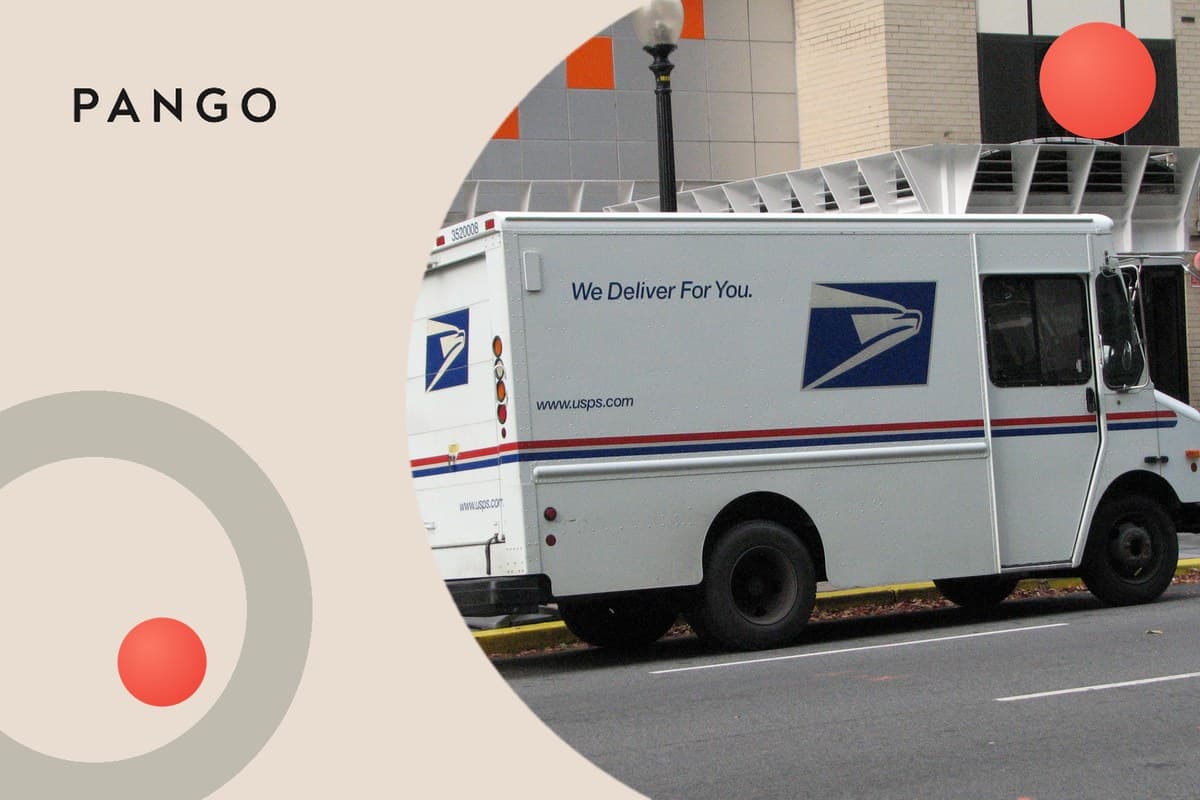
The United States is where most of our readers' parcels are, and where most of the delivery questions come from: 36 percent of all the status searches reaching pango.ai in the October Parcel Anxiety Index, more than twice the next country. The carriers are three national networks with published service windows, a federal rule on when an order has to ship, a returns culture built on drop-off counters rather than the post, and a shopper who searches "processed through USPS facility" or "departed FedEx hub" instead of waiting. This guide is the merchant's map: what USPS, UPS and FedEx each publish, the one federal rule that shapes the dispatch promise, how returns work in practice, and what has to be true in your tracking setup before "delivered but not received" becomes your largest ticket category.
Short answer: Three carriers carry most DTC parcels. USPS publishes Ground Advantage at 2 to 5 days with tracking and $100 of insurance included, and Priority Mail at 2 to 3 days with no surcharges for fuel, residential, rural or Saturday delivery. UPS publishes Ground for economical domestic delivery and day-definite options, with Saturday delivery available for most regions on its standard service. FedEx publishes Ground and Home Delivery at 1 to 5 business days in the contiguous US (3 to 7 to Alaska and Hawaii), Home Delivery every day of the week including Saturday and Sunday, with a residential surcharge per package. The federal Mail, Internet, or Telephone Order Merchandise Rule requires you to ship within the time you advertise or, if you state none, within 30 days, and to get the customer's consent or refund them if you cannot. Returns run through drop-off networks: USPS Ground Advantage Return, the carriers' own stores, and box-free counters such as Happy Returns' nearly 10,000 Return Bars. The fix for the US is a tracking page that reads USPS, UPS and FedEx statuses onto one plain set, carries the expected date, and treats "delivered" as the start of a check, not the end of the job.
The carriers, side by side
| Carrier | Service | What the carrier publishes | Notes for a brand |
|---|---|---|---|
| USPS | Ground Advantage | "Delivered in 2-5 days" with USPS Tracking included; $100 insurance included on outbound and return shipments; negotiated pricing for businesses; Ground Advantage Return for customer returns | The default economy service for light DTC parcels; the return label is the same product |
| USPS | Priority Mail | "Tracking and delivery in 2-3 days"; up to $100 insurance with most shipments; "No surcharges for fuel; residential or rural delivery; or Saturday delivery"; Flat Rate boxes up to 70 lbs at one price to any state | The no-surcharge line is the one to read twice: residential and Saturday delivery cost extra on the private carriers |
| USPS | Priority Mail Next Day | Next-business-day delivery within 150 miles of participating locations in more than 60 markets, for businesses with a negotiated service agreement | Regional, account-based |
| UPS | Ground | "Reliable delivery without breaking the bank"; Flat Rate options; Ground with Freight Pricing for 150 lb and over | Day-definite; UPS Standard offers day-definite delivery in 2 to 7 days with Saturday delivery available for most regions |
| FedEx | Ground | "Cost-effective delivery in 1-5 days" (3 to 7 business days to and from Alaska and Hawaii); packages up to 150 lbs; delivers throughout all 50 states | Business addresses |
| FedEx | Home Delivery | 1 to 5 days within the contiguous US, "every day of the week, including Saturday and Sunday"; reaches over 98 percent of the US; a residential surcharge per package | Residential addresses; the seven-day delivery is the point |
| Amazon Logistics | AMZL | Amazon's own network, for orders sold on Amazon | Its statuses are their own vocabulary, decoded in Amazon Logistics tracking |
Two things to read from the table. First, the residential surcharge is where DTC economics live: FedEx states a per-package residential surcharge on Home Delivery and USPS states none, which is why light parcels so often go USPS and heavier or faster ones go FedEx or UPS. Second, every one of these services publishes a day window, not a guarantee, and the window is what your tracking page should carry as the expected date.
The federal rule on when you have to ship
The FTC's Mail, Internet, or Telephone Order Merchandise Rule, issued in 1975 and updated for internet orders, is the one piece of federal law every DTC brand ships under. The rule requires a seller to have a reasonable basis for expecting it can ship within the advertised time frame or, if no time frame is stated, within 30 days of receiving the order. If you learn you cannot ship within the stated time or within 30 days, you must seek the customer's consent to the delay. A first delay notice with a revised date of 30 days or less may treat silence as consent; a notice with a later date, or no date, must tell the customer that the order will be cancelled automatically within the originally promised time plus 30 days unless they respond. If you cannot ship any of the merchandise, you must refund the entire amount.
For a brand this is a dispatch promise and a message, not a legal footnote. The promise you print at checkout is the clock the rule runs on, and the delay notice is a customer communication that has to go out before the clock expires. A tracking system that knows an order has not shipped against its promise is the only reliable way to send that notice on time.
Why US shoppers search for statuses so much
The queries are the carriers' own wording. In the 28 days to 17 October, "departed FedEx hub" and its variants drew about 1,800 searches to pango.ai, "processed through USPS facility" and "processing at USPS facility" about 1,500, "departed USPS facility" nearly 800. Each is a shopper trying to decode a scan the carrier did not explain, and each is a question a store's support inbox would otherwise receive. The glossaries that absorb them are USPS tracking statuses, UPS tracking statuses and FedEx tracking statuses. The US was also where "delivered but not received" grew fastest in the index, the status most likely to end in a refund.
Returns: counters, not post offices
US returns run on drop-off networks. USPS sells Ground Advantage Return as the mirror of its outbound service, with the same $100 of insurance. UPS and FedEx take returns at their stores and drop boxes. And a growing share of returns are box-free: Happy Returns, part of UPS, runs nearly 10,000 Return Bar locations where the customer hands over the unboxed item with a QR code and the refund is triggered at the scan, which is why "happy returns locations" became one of the largest returns queries in our data. How that counter works, from the customer's side, is in Happy Returns locations. For a brand the operational questions are the same as everywhere: which network the customer drops at, whether the refund waits for the warehouse or fires on the carrier's first scan, and whether the return can become an exchange.
The statuses a US merchant has to know
| Status | Carrier | What it means for the store |
|---|---|---|
| "Shipping label created, USPS awaiting item" | USPS | Label printed, parcel not scanned; the customer sees "shipped" and nothing moving |
| "Processed through USPS facility" / "processing at USPS facility" | USPS | A hub scan; the quiet stretch |
| "Departed FedEx hub" / "departed FedEx location" | FedEx | Left a hub; the next scan is the destination facility |
| "Out for delivery" | All | The customer needs to be home or have a safe place; the most searched status in the index |
| "Delivered" with no parcel | All | The status most likely to become a refund; a proof-of-delivery photo and the drop location change the outcome |
Each is decoded, with what comes next and when to act, on the carrier pages linked above; the "delivered but not received" case has its own page at package says delivered but not received.
Where Pango sits
Pango connects USPS, UPS, FedEx and the regional and international carriers that hand over to them on one record, routes each order to the service that meets the promise at the best cost, prints the label, runs pick and pack, normalises the three networks' statuses onto one plain milestone set on the brand's own tracking page with the expected date, treats a parcel that stops against its promise as a trigger for a proactive message, and runs returns and exchanges with labels and refund logic per merchant. If you ship in the US and "where is my order" or "it says delivered" is a standing ticket category, the free shipping and returns audit shows on your own orders which carriers and statuses generate them, and the software category to compare is carrier management software. The UK, Italian and Nordic versions of this guide are shipping to the UK, shipping to Italy and the Nordic shipping and returns guide.
The bottom line
The US is three networks with published windows, a federal clock on dispatch, and returns at counters. Route by the promise and the surcharge, carry the carrier's window as the expected date on your own tracking page, send the delay notice before the FTC clock runs, give returns a drop-off network and a refund trigger, and treat "delivered" as the moment to check rather than the moment to stop. Do that and the largest source of delivery questions in the world stops reaching your support inbox.